Sustainability
Q&A with Resident Marine Biologist and Sustainability Manager Emeline Bouchet
Velaa Private Island has successfully transplanted over 11,000 nursery grown corals, covering 25% of the reef area surrounding the island. Can you tell us a bit more about the process, your research and how you achieved such growth?
The process has been meticulously planned and has involved several pilot studies to establish a suitable methodology for the regeneration project. We opted to utilise the floating coral nursery technique due to the characteristics of the island (shallow lagoon) and environmental factors such as currents, sedimentation, and potential predators.
Currently, there is one large-scale floating nursery housing 1000 corals, along with a separate floating nursery dedicated to coral adoption, allowing guests to participate. Additionally, there are five small-scale reef nurseries. The initial stage of the regeneration process involves attaching fragmented or broken coral to ropes, which are then left to float in the vicinity of the nursery. After approximately nine months in the nursery, protected from predators, the coral will thrive and grow, reaching a size suitable for transplantation onto the house reef. Transplantation marks the second phase of the project, wherein coral is carefully moved to areas with existing healthy coral, where favourable survival and growth conditions exist.
The introduction of the Biorock™ project, which employs electrified steel structures to stimulate coral growth using safe low-voltage electricity, has further enhanced survival rates and increased species diversity. Moreover, it has accelerated growth rates by up to tenfold. Corals planted on Biorock™ structures have a greater chance of withstanding future predicted bleaching events.
What threatens the health of the coral most?
The Maldives boasts approximately 1,200 islands, each encircled by coral reefs, rendering it one of the premier destinations globally for snorkelling and diving due to its marine biodiversity and abundance.
Global warming stands as the foremost threat to coral populations in the Maldives. Corals are exceedingly sensitive to environmental changes, particularly fluctuations in temperature. Following the significant bleaching event of 1998, corals were in the process of recovery when they faced another natural phenomenon in 2016—El Niño—along with another in 2020, resulting in mass bleaching without mortality. The El Niño effect entails prolonged periods of elevated sea surface temperatures in the tropical Pacific Ocean, exacerbated by global warming. The 2016 phenomenon led to a staggering 60% reduction in average coral cover, subsequently impacting fish abundance and diversity.
The onset of the fourth global mass bleaching event has been catalysed by extraordinary ocean temperatures, spelling dire consequences for marine life and the millions of people reliant upon it. With global temperatures on the rise, such events are anticipated to occur more frequently and persist for longer durations.
Anthropogenic activities also pose a threat to corals, notably pollution and overfishing. Annually, millions of tonnes of plastic waste infiltrate our oceans, persisting for centuries and disintegrating into microplastics. Marine organisms ingest these microplastics, which have been detected in seafood consumed by humans, potentially introducing harmful chemicals and toxins into our food chain. Larger plastic debris ensnares marine life, inflicting injuries and disrupting ecosystems, with ramifications for biodiversity and the planet’s health. The economic ramifications of plastic pollution are substantial.
Could you tell us more about the house coral reef at Velaa and which coral species are most prevalent?
Through the implementation of innovative strategies such as the Biorock™ project, the establishment of small-scale nurseries, and the direct transplanting of fragmented coral species, remarkable progress has been made in enhancing the genetic diversity of our coral reef. Diverse species including Pocillopora, Acropora, Heliopora, Pachyseris, Diploastrea, Astreopora, alongside numerous other massive species, now contribute to our ecosystem.
We also developed a method to grow soft corals, followed by transplantation, after two weeks, back onto the reef. We add anemones to our Biorock™ structures which attract clownfish, damselfish, as well as different species of invertebrates.
Is there evidence that the number of species and the diversity of species has increased over the years?
We conduct benthic, fish and invertebrate surveys of our coral transplanted area, which we compare with results from a degraded area and our Biorock™ site. The Biorock™ site exhibited the highest levels of abundance, closely followed by transplant sites, while degraded areas exhibited comparatively lower levels of biodiversity.
In addition, we have a long-term time-lapse monitoring in place, which takes 340+ photos over a 10-day time-lapse, which we use to track long-term changes in our Biorock™ sites, as well as weekly remote underwater video where the abundance and diversity of fish are monitored.
Every species in an ecosystem interacts, each taking different roles and none more important than another. This has inspired a shift in the focus of our coral regeneration project, which now primarily aims to increase the diversity of coral to build a reef with more complexity, eventually encouraging increased fish diversity.
How can guests get involved?
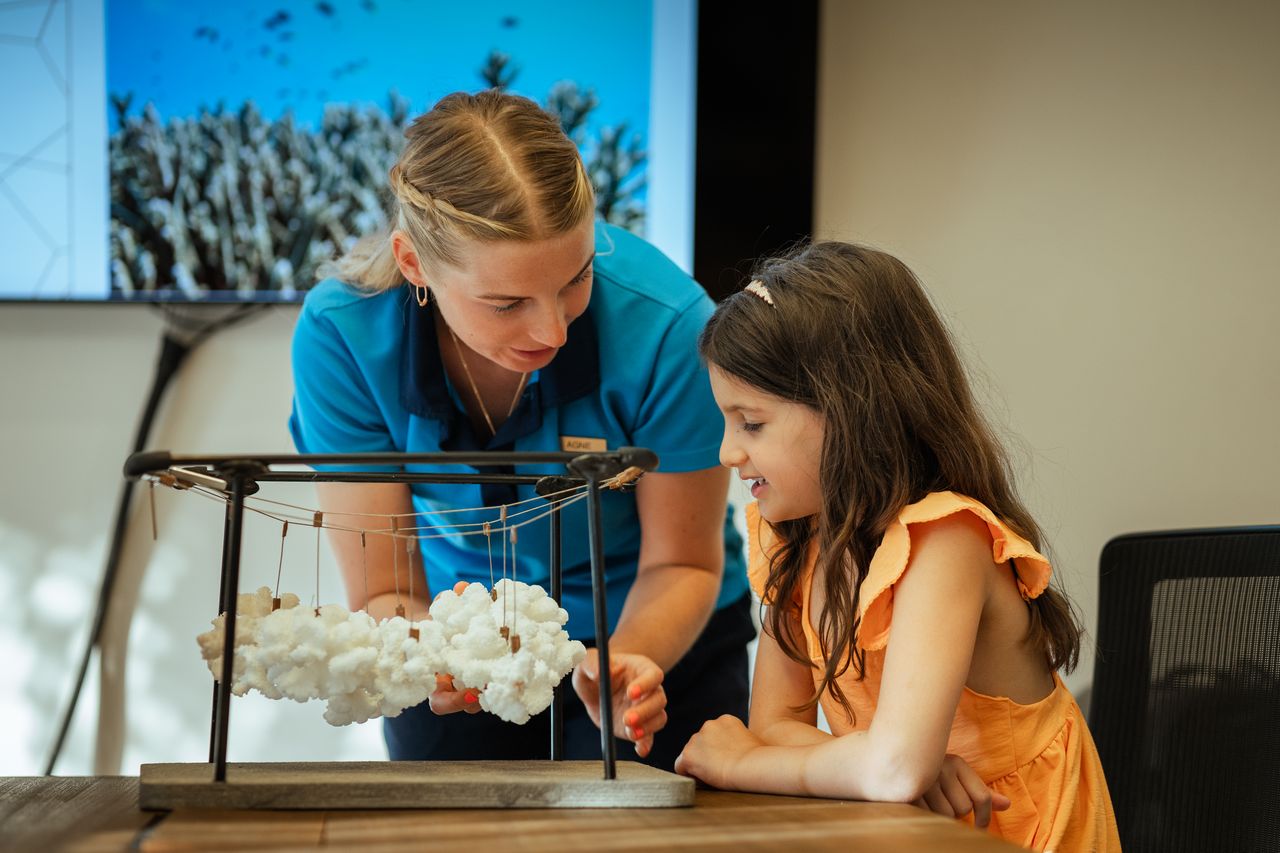
Our guests can contribute to the project by adopting corals. They are invited to view an educational presentation about marine life and the reef ecosystem, highlighting the importance of its protection.
After the presentation, the marine team helps our guests to attach and monitor corals on the rope. Guided by the dedicated team, guests can also put their corals on the nursery via scuba diving or snorkelling. We then provide them with a certification of adoption and update them on the health of their adopted coral ongoing once they’ve returned home.
Youngsters can get involved in our Young Marine Biologist Programme, which is in collaboration with the Kids Club. There are four weekly activities, and they can gain hands-on experience on various topics including coral transplanting, turtle nesting, lab science and identifying different species of fish.
Another activity offered to our guests is to be a part of the marine team for a day. They are invited to shadow the coral biologists who live on the island while they snorkel or scuba dive to collect research.
We also provide awareness-raising workshops focused on shark population, sea turtle nesting or plastic pollution impact on local marine life. The end goal is to inspire more guests to get involved in ocean protection and conservation, with a view to spreading awareness and finding solutions to preserve the biodiversity which is drastically decreasing every year.
Can you tell us more about turtle and manta ray conservation on the island?
Velaa Private Island is working in cooperation with the Olive Ridley Project and Manta Trust. Anytime there is an encounter with manta rays or turtles on the house reef or an island nearby, we transfer the information and pictures to the relevant organisations for identification. In the past year, we have identified ten turtle individuals, and 11 mantas, including three individuals never recorded before, that we were able to name. If the team encounters and rescues any entangled or injured turtles, we cooperate with veterinarians from Marine Savers or Atoll Marine centre.
Velaa translates as green turtle in Dhivehi (Maldivian language) because female sea turtles typically nest on the island during the nesting season, between March and August. The nesting process requires a lot of energy from the females travelling to the island, so we try to make it less stressful for them in order to increase the nesting success rate.
What’s the plan for 2024?
We will expand our Biorock™ project, putting a new system in a different location of the island. This will rejuvenate the degraded reef, fostering the growth of coral communities, enhancing biodiversity, and providing crucial habitats for marine life. In addition, Biorock™ will contribute to shoreline protection, mitigating coastal erosion and safeguarding the island’s ecosystems against the impacts of climate change.
Are you looking to get involved in other types of marine conservation?
The aim of the project is not only to help regenerate the reef but to spread awareness in terms of the impact we have on the ocean. We conduct sessions for our resort guests, employees as well as working with the local community to help educate them on the coral reef ecosystem and explain it is important to protect it for the future. In 2023, we joined two environmental Festivals organised by local islands to provide awareness about Plastic pollution. We participated in the Little Big Festival in Kudafaree, Noonu Atoll and Turtle Festival in Lhaviyani Atoll, which both help increase community understanding of sustainability principles.